Don’t Just Look at the Title Deed When Buying Land! 7 Risk Points to Check Before Transfer
Land with a title deed, low price, and good location—so why is some land hard to resell?
The answer is that having a title deed does not guarantee that the land is suitable for investment or can be used for all purposes.
Many buyers decide to purchase land because the price is below market value but forget to check access routes, zoning, boundaries, encumbrances, and development costs.
Some plots require hundreds of thousands of baht for land filling, some have no legal access, and others cannot be developed as planned.
PK HOME INVEST presents 7 risk points buyers should verify before paying a deposit or transferring land ownership.
1. Verify the Title Deed and Ownership
The first step is to check the ownership documents and land registry information.
Do not rely solely on a copy of the title deed provided by the seller, as it may not be up to date.
You should confirm:
Whether the owner’s name matches the seller
If the title deed number, land plot number, and area are correct
Whether there are any registered mortgages, easements, or other encumbrances
If the seller has the authority to sell or any transaction restrictions
Whether the land is under seizure or involved in disputes requiring further investigation
You can request verification of land registry documents at the Land Office according to the Department of Lands’ procedures.
Investor’s perspective: Seeing the original title deed is just the beginning; verifying current registry data is what reduces risk before purchase.
2. Check Land Access
Land without legal access can become difficult to resell and develop.
Buyers should confirm whether the land borders a public road. If access is through private land, the right of way must be clearly established.
Consider the following:
Is the access a public or private road?
Is there a registered easement?
Is the road width sufficient for intended use or construction?
Are there any obstacles or disputes regarding the access?
Although the law provides for necessary access rights if the land has no public road frontage, exercising these rights must comply with legal conditions and may involve compensation or disputes.
Investor’s perspective: Cheap land without secure legal access may carry higher risk and costs than more expensive land with proper road frontage.
3. Verify Zoning Before Purchase
Not all land can be used for houses, commercial buildings, factories, or warehouses as desired.
Land use may be restricted by zoning ministerial regulations, building control laws, and special area laws.
For example, an investor wanting to build a warehouse may find use restrictions upon reviewing zoning rules.
Before buying, check:
Land use type according to zoning
Restrictions on building types and businesses
Permitted building height and size
Setback and related requirements
Special area laws such as building control zones or environmental protection zones
You can start by checking the Department of Public Works and Town & Country Planning’s system and request official land use verification letters if needed.
Investor’s perspective: Don’t buy land just because you believe you can build anything in the future; true value depends on what the law permits.
4. Confirm Boundaries and Actual Area
The area stated on the title deed and the actual possession must be consistent.
Some plots may have fences not aligned with boundaries, missing boundary markers, or overlapping use with neighboring plots.
Before buying, survey the actual land. If uncertain, ask the owner to request a boundary survey from the Land Office.
This check is especially important for high-value land, large plots, or land intended for project development.
Investor’s perspective: Don’t pay for the area on paper without verifying the usable land area in reality.
5. Check Flood History and Land Elevation
Land that looks good in the dry season may have problems during the rainy season.
Check the land elevation relative to roads and surrounding areas, flood history, and drainage systems.
Basic checks include:
Asking locals about flood history
Surveying water marks on the land
Checking flood risk data from government agencies
Assessing the need for land filling and drainage improvements
Cheap land may not be truly inexpensive if significant funds are needed for preparation before construction.
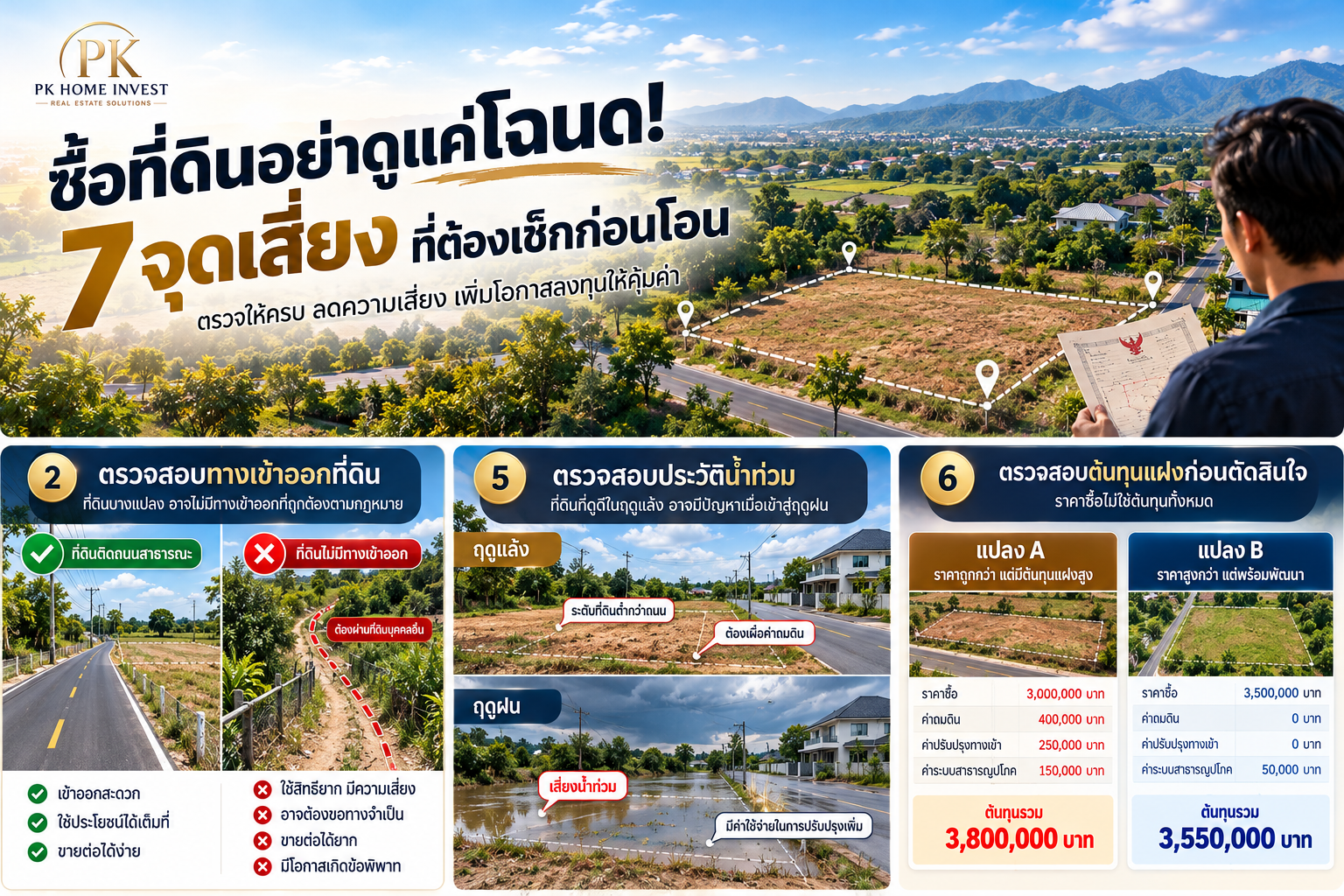
6. Assess Hidden Costs Before Deciding
Suppose there are two land plots to choose from:
| Item | Plot A | Plot B |
|---|---|---|
| Purchase Price | 3,000,000 | 3,500,000 |
| Land Filling Cost | 400,000 | 0 |
| Access Improvement Cost | 250,000 | 0 |
| Utility System Cost | 150,000 | 50,000 |
| Total Cost | 3,800,000 | 3,550,000 |
These figures are hypothetical examples, not actual land appraisals, and exclude taxes, fees, interest, and other expenses.
Plot A’s purchase price is 500,000 baht cheaper, but after including preparation costs, its total cost is 250,000 baht higher than Plot B.
Investor’s perspective: Purchase price is not the total cost; buying cheap does not always mean a good deal.
7. Evaluate Resale Potential and Liquidity
Before buying land, investors should ask themselves:
“If I had to sell this land within 6 months, would anyone want to buy it?”
This question helps shift perspective on the investment.
Holding land does not automatically generate cash flow and may take time to find a buyer willing to pay the asking price.
Consider factors such as:
Is there real demand in the area?
Who is the target buyer group?
Are there comparable sales?
Can the land be subdivided or developed?
How much price reduction would be needed for a quick sale?
Listed prices by other owners are not proof that the market will transact at those prices.
Investor’s perspective: Real estate profit does not come solely from buying cheap but from having the opportunity to sell or use the land to generate returns.
7-Point Checklist Before Buying Land
| What to Check | Risk if Not Checked |
|---|---|
| Title Deed and Ownership | Ownership issues and encumbrances |
| Access | Difficult to use or resell |
| Zoning | Cannot develop as planned |
| Boundaries and Area | Incorrect area or disputes |
| Flood History | High improvement costs |
| Hidden Costs | Overbudget investment |
| Resale Potential | Illiquid investment |
Frequently Asked Questions (FAQ)
1. What should I check first before buying land?
Start by verifying the title deed, ownership, and land registry information at the Land Office, along with inspecting the actual location and condition of the plot.
2. Can I buy land without legal access?
It is possible if the seller has ownership and can legally transfer it, but buyers should carefully verify access rights as there may be issues using or reselling the land.
3. Where can I check zoning information?
You can check preliminary information through the Department of Public Works and Town & Country Planning’s system and contact responsible agencies to confirm the land’s zoning requirements.
4. If there is a title deed, is a survey necessary before purchase?
Not always, but if boundaries are unclear, markers are missing, or disputes exist, it is advisable to request a boundary survey before the transaction.
Summary: Good Land Is Not Just Cheap Land
Investing in land requires a comprehensive view of ownership, location, usability, development costs, and future liquidity.
Sometimes paying more for land with clear documents, good access, and development potential is a wiser decision than buying cheap land full of restrictions.
PK HOME INVEST believes that good real estate investment starts with recognizing risks before focusing on profits.
Learn more about real estate and investment perspectives at www.pkhomeinvest.com
Note: This article provides general knowledge and is not legal advice or a guarantee of suitability for any specific land plot. Buyers should verify information with relevant authorities before transactions.
This article references guidelines and information from government agencies, especially regarding land registry verification, surveying, and land use according to zoning.
Department of Lands — Land plot search system and land registry services
Land Use Verification System According to Zoning — Check information and request official land use verification letters
Guidelines for requesting boundary surveys from the Department of Lands